
1. Introduction
Noise has recently emerged as one of the most critical environmental concerns affecting daily human activities, especially in production and transportation. Unlike sounds generated from everyday activities, noise emitted from operating machinery – such as in factories or vehicles – has much greater intensity and impact, and must be treated as a pollution issue, known as noise pollution [1, 6]. Above all, it is necessary to apply standards for evaluating measured noise data and to ensure effective design solutions for noise prevention and reduction, in order to protect operators and nearby residents.
When approaching the field of noise, the issues of measurement, evaluation techniques, and noise control need to be clarified across most technical domains. Specifically in the maritime sector, guidelines for ship noise management often apply proposed criteria to assess the severity of noise on board, particularly in living quarters and workspaces, in relation to maintaining daily activities. More specifically, it is also necessary to consider noise in connection with hearing loss and the ease of verbal communication in all tasks performed on the ship.
The issue of ship noise impacts on the underwater ecosystem as well as on crew members and passengers was first raised in 2004 at the International Maritime Organization (IMO). In 2008, the Marine Environment Protection Committee (MEPC) agreed to develop non-mandatory technical guidelines to mitigate noise from shipping activities. The IMO noise standard MSC.337(91) was published and has since become a widely used benchmark for assessing ship noise [2, 7]. Vietnam’s QCVN 24:2016/BYT also sets permissible workplace noise exposure limits.
In general, for areas where sound levels are consistently below 75 dB(A), only a simple noise risk assessment is needed, without corrective action. For areas with levels between 75 and 85 dB(A) over a certain period, an initial survey using sound level meters is required. Particularly, areas with 8 hour noise exposure levels of 80 dB(A) or higher demand a full survey with clear identification of exposure levels and corresponding actions. Ideally, noise sources should be listed and individual noise exposure estimated for all workers who may be at risk of hearing loss due to noise. Given the long duration work at sea, both crew members and passengers should undergo comprehensive noise exposure assessments.
Controlling maximum noise levels helps: protect crew members from noise that may cause hearing loss; provide an acceptable level of comfort in living spaces on board; create conditions for recovery from the effects of high-level noise exposure; ensure safer workplaces by maintaining verbal communication and audibility of alarms in control, navigation, and radio areas; and safeguard operable machinery spaces.
This study addresses the application of standards and the evaluation of noise levels based on measured data in different areas of an operating ship with crew and passengers on board. Actual measurements were taken using sound pressure level meters during sea trials of a newly built vessel, and the analyzed data were compared against IMO’s MSC.337(91) standard as well as other relevant regulations such as Vietnam’s QCVN 24:2016/BYT [4] and ISO 9612:2009 [5]. This forms a technical method for determining occupational noise exposure for specific job positions across various areas of the ship in operation.
In this context, the paper evaluates occupational noise exposure on board ships by comparing measured levels against the limits established in IMO’s noise regulation MSC.337(91) and Vietnamese national technical regulation QCVN 24:2016/BYT, which together serve as the main technical basis for workplace noise control. It introduces a methodological framework for measuring workers’ exposure to noise in confined environments such as ships, and for calculating daily occupational noise exposure. Noise measurements were conducted in accordance with ISO 9612:2009 during sea trials of a newly built vessel. The study presents measurement results, analysis, and assessment of sound levels at various shipboard locations, along with evaluations of occupational noise exposure by work area and job position over a typical working day. The findings offer useful information for prioritizing noise control measures on ships in operation. Furthermore, the research highlights the importance of integrating international and national standards to ensure consistency in occupational safety practices. The proposed methodology can serve as a reference for future studies and as a practical guide for ship operators seeking to implement sustainable noise management strategies.
2. Noise measurement parameters and evaluation methods
2.1. Noise measurement parameters
Sound level meters are commonly used to measure sound pressure levels; sound pressure is expressed in decibels (dB) relative to the standard reference level of 20 μPa. These meters typically allow the selection of weighting scales, such as weighted sound levels A, B, C, and D defined in IEC 61672-1 [3], are used to adjust the initial dB readings. The choice of weighting scale depends on the overall measured sound level, considering whether background noise is included: scale A is used for 20–55 dB, scale B for 55–85 dB, and scale C for 85–140 dB.
2.1.1. Continuous Equivalent A-Weighted Sound Level, LAeq(T). The A-weighted sound pressure level of stable and continuous noise over a time period T, has the same root mean square value as the time-varying sound pressure. It is expressed in A-weighted decibels (dB(A)) and calculated as follows [5]:
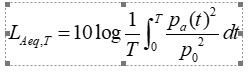
where: T - measurement time; pa(t) - instantaneous A‑weighted sound pressure level; p0 = 20 mPa (standard reference value).
2.1.2. Peak sound Level, LCpeak. The maximum instantaneous sound pressure level with C‑weighting is expressed in dB(C) and calculated as follows:
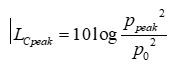
where: ppeak = instantaneous C‑weighted sound pressure level; p0 = 20 mPa.
2.1.3. Daily noise exposure level, Lex,24h. The daily noise exposure level represents the equivalent noise exposure over a 24‑hour cycle:

where: T - machine operating time; T0 - standard reference time (T0 = 24 hours).
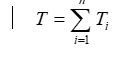
2.1.4. Continuous equivalent A‑weighted sound pressure level, LAeq,T. The overall equivalent A‑weighted sound pressure level is derived from individual sound levels LAeq,Ti for each time periods, using the following formula:

where: LAeq,Ti – the continuous equivalent sound level, expressed in decibels (dB), averaged over the time interval Ti; and
2.2. Noise measurement instruments
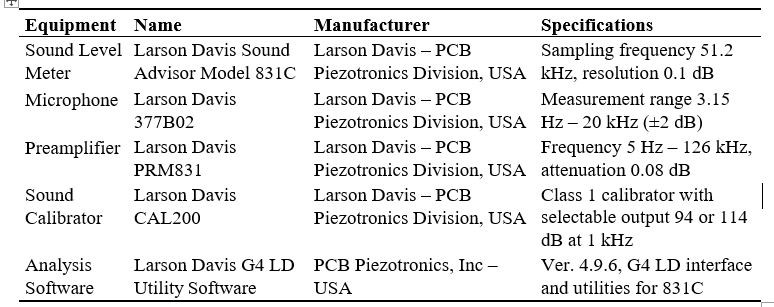
Sound pressure level measurements are performed using a precision sound level meter, with the class determined by the applicable standard. The meter must comply with IEC 61672‑1 Class 1 (2002‑05) [3] or an equivalent accepted standard. The acoustic calibrator must comply with IEC 60942 (2003‑01) and is typically supplied by the manufacturer with a calibration certificate. The microphone head is fitted with a windscreen to minimize environmental effects such as wind, rain, and dust. Table 1 lists the main equipment used for noise measurement.
Table 1. Noise measurement instruments
2.3. Determination of estimated noise exposure levels
The noise measurement procedure is carried out as follows:
- During the noise measurement process, only personnel essential to the operation of the vessel and those involved in the measurement are present in the relevant space, i.e., the area to be measured.
- Sound pressure level indicators are recorded in dB(A) and dB(C), and, if necessary, also in octave bands between 31.5 Hz and 8,000 Hz.
The procedure for determining noise exposure level is proposed as follows:
- In addition to measuring continuous sound levels, the noise exposure level of crew members at work is determined based on ISO 9612:2009.
- To ensure that personnel are not exposed to Lex(24) exceeding 80 dB(A), a simple procedure for determining the relevant exposure level must be specified in order to calculate the A-weighted daily exposure level, Lex(24). Specifically:
(i) Work analysis based on job profiles, working and off-duty hours:
(a) Based on the crew list, different jobs categories (groups) will be defined, such as chief engineer, electrician, cook, and others;
(b) For each job category, a job profile has to be defined individually. The job profile is related to the working spaces on board the vessel, such as wheelhouse, ship office, machinery control room, workshop, engine room, galley, etc;
(c) For each job category, the work shift is divided into partitions corresponding to the workspaces. A similar assessment should also be conducted for off-duty hours.
(ii) Determination of estimated noise exposure level:
(a) Based on the noise report and the estimated working time & off duty hours for each job category, the noise exposure level is calculated;
(b) The noise contribution from each space is calculated as follows:

where: Ti – effective duration, in hours, of the working day on board for each space; T0 – reference duration, T0 = 24 h; LAeq,i – A-weighted equivalent continuous sound level, in decibels, averaged over time interval Ti;
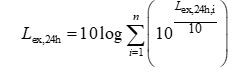
(c) The A-weighted noise exposure level is calculated from the noise contributions from each space as follows:
2.4. Noise level limits and noise exposure limits
2.4.1. Noise level limits. The prescribed noise limits represent maximum permissible values, not desired levels. In practice, noise should remain below these limits. Before a ship enters service, compliance must be verified by measuring the continuous equivalent sound level in each space. In large areas, multiple positions should be measured to determine the highest value. Operators exposed to nominal noise levels above 85 dB(A) must wear hearing protection. A limit of 110 dB(A) applies under the assumption that hearing protection requirements are met. Crew must be instructed accordingly, as documented in the ship’s safety management system. No operator should be exposed without hearing protection to peak levels exceeding 135 dB(C).
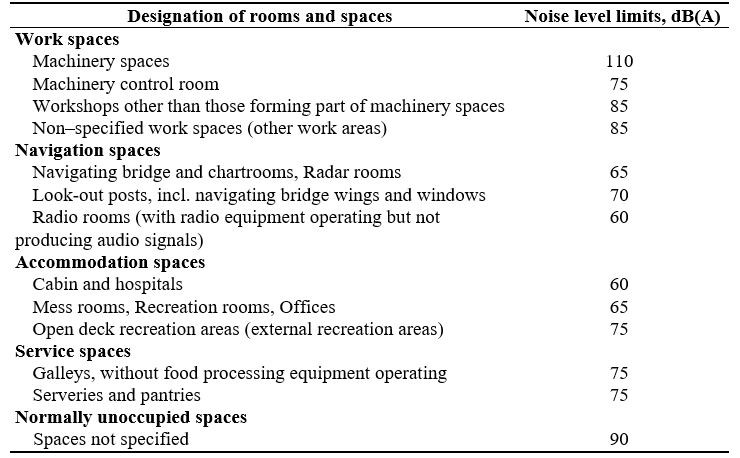
Noise level standard MSC.337(91) establishes mandatory limits for onboard spaces (Table 2). It covers key aspects such as specifications for measuring equipment, measurement positions and methods, sound pressure level limits, and exposure limits. Importantly, it is the most widely applied standard for ship noise assessment.
Table 2. Limits for noise level specified for various spaces under IMO MSC.337(91)
2.4.2. Noise exposure limits. Noise limits are set to ensure that seafarers are not exposed to a daily equivalent level, Lex, 24h, exceeding 80 dB(A). In spaces where noise exceeds 85 dB(A), hearing protection must be provided or exposure time restricted (see Fig. 1) to guarantee equivalent protection. A maximum of 110 dB(A) is permitted under the assumption that hearing protection is properly used. Crew must be instructed accordingly, as documented in the ship’s safety management system. Finally, no personnel should be exposed without hearing protection to peak levels above 135 dB(C).
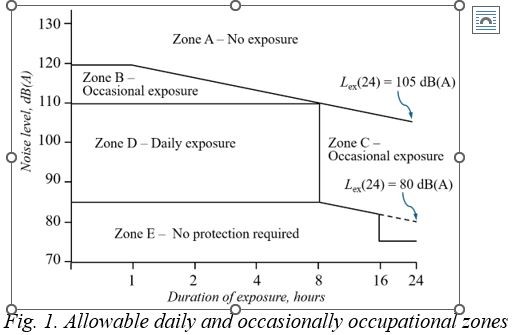
The noise exposure limits for workers shall not exceed the levels and durations specified in Fig. 2, with details for each zone as follows:
- Zone A – Maximum exposure with hearing protection: No exposure above 120 dB(A) or Leq(24) greater than 105 dB(A).
- Zone B – Occasional exposure: Allow only occasionally, and hearing protection must reduce noise levels by 25 to 35 dB(A).
- Zone C – Occasional exposure: Allow only occasionally, and hearing protection must reduce noise levels by at least 25 dB(A).
- Zone D – Daily (continuous) exposure: For 85–110 dB(A), regular daily work requires hearing protection reducing noise levels by at least 25 dB(A). Risk assessments must be conducted, and a hearing conservation program should be considered.
- Zone E – Exposure under 8 hours: Without hearing protection, noise levels must not exceed 85 dB(A). For exposures longer than 8 hours in high-noise spaces, Leq(24) shall not exceed 80 dB(A). Therefore, for at least one-third of each 24-hour period, each worker should remain in an environment with noise levels below 75 dB(A).
Note: In Zones A–D, hearing protection must be used to reduce noise below 85 dB(A). In Zone E, protection is not required unless noise exceeds 80 dB(A) for more than 8 hours.
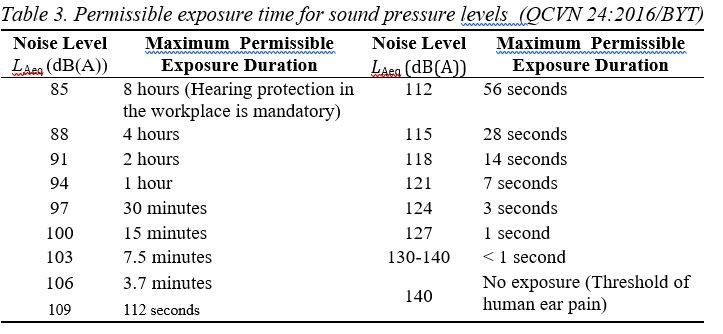
24 hour equivalent continuous noise limit: No personnel shall be exposed to a 24 hour equivalent continuous noise level above 80 dB(A) without hearing protection. Daily exposure in spaces requiring protection must not exceed 4 continuous hours or a total of 8 hours per day (see Table 3).
3. Results and Discussion
Noise measurement, analysis, and evaluation were carried out on the newly built vessel Luntos (IMO No. 9894935) during its 2021 sea trial in Vung Tau City (Fig. 2). The measured values were compared against the permissible limits in Table 2. Measurement positions were identified directly on the vessel’s general arrangement drawing. The measured noise levels (above) and the permissible limits (below) for each space are illustrated in Fig. 3 and Fig. 4.
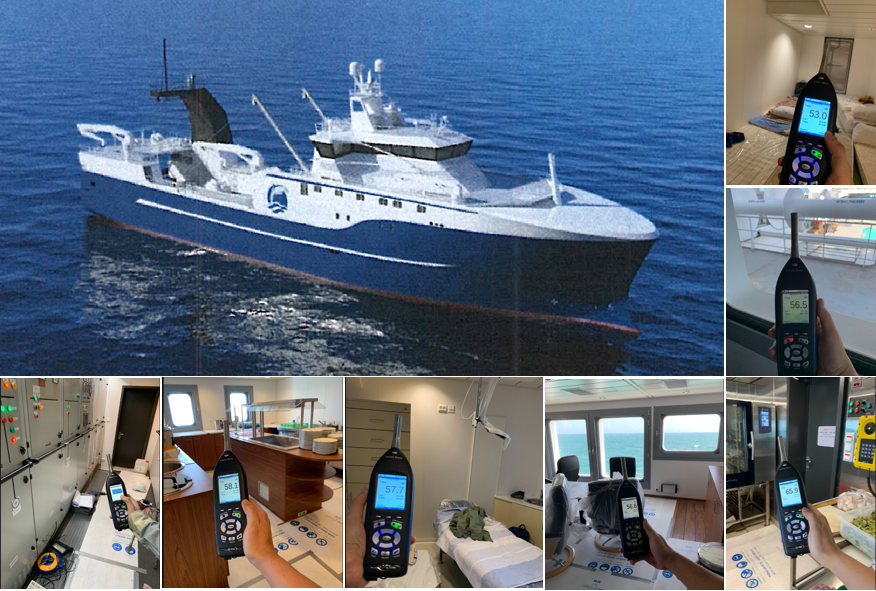
Fig. 2. Luntos Vessel (2021) with selected noise measurement points
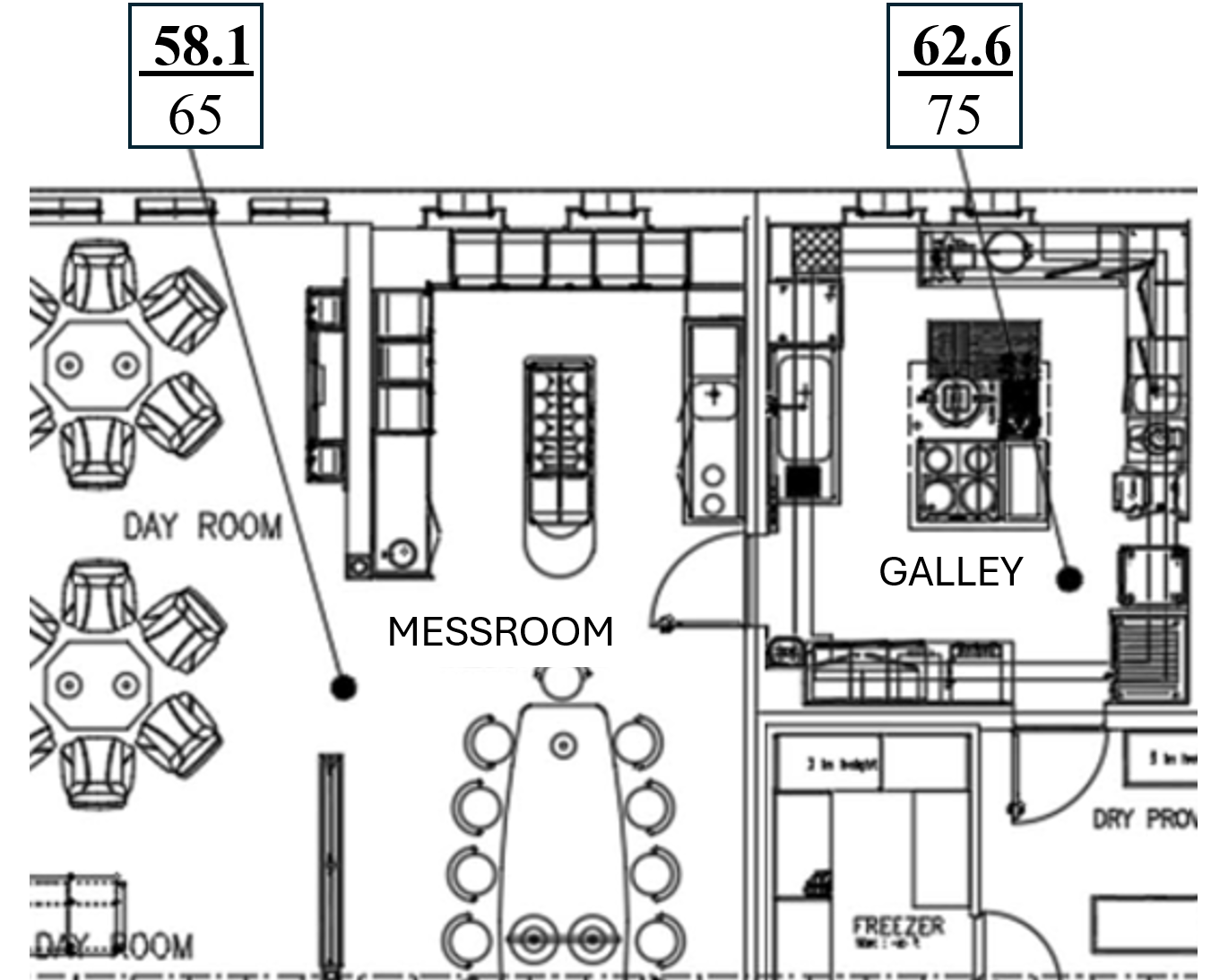
Fig. 3. Measured noise level in the Mess Room and Galley compared to the permissible limits (58.1/65 dB(A) and 62.6/75 dB(A))
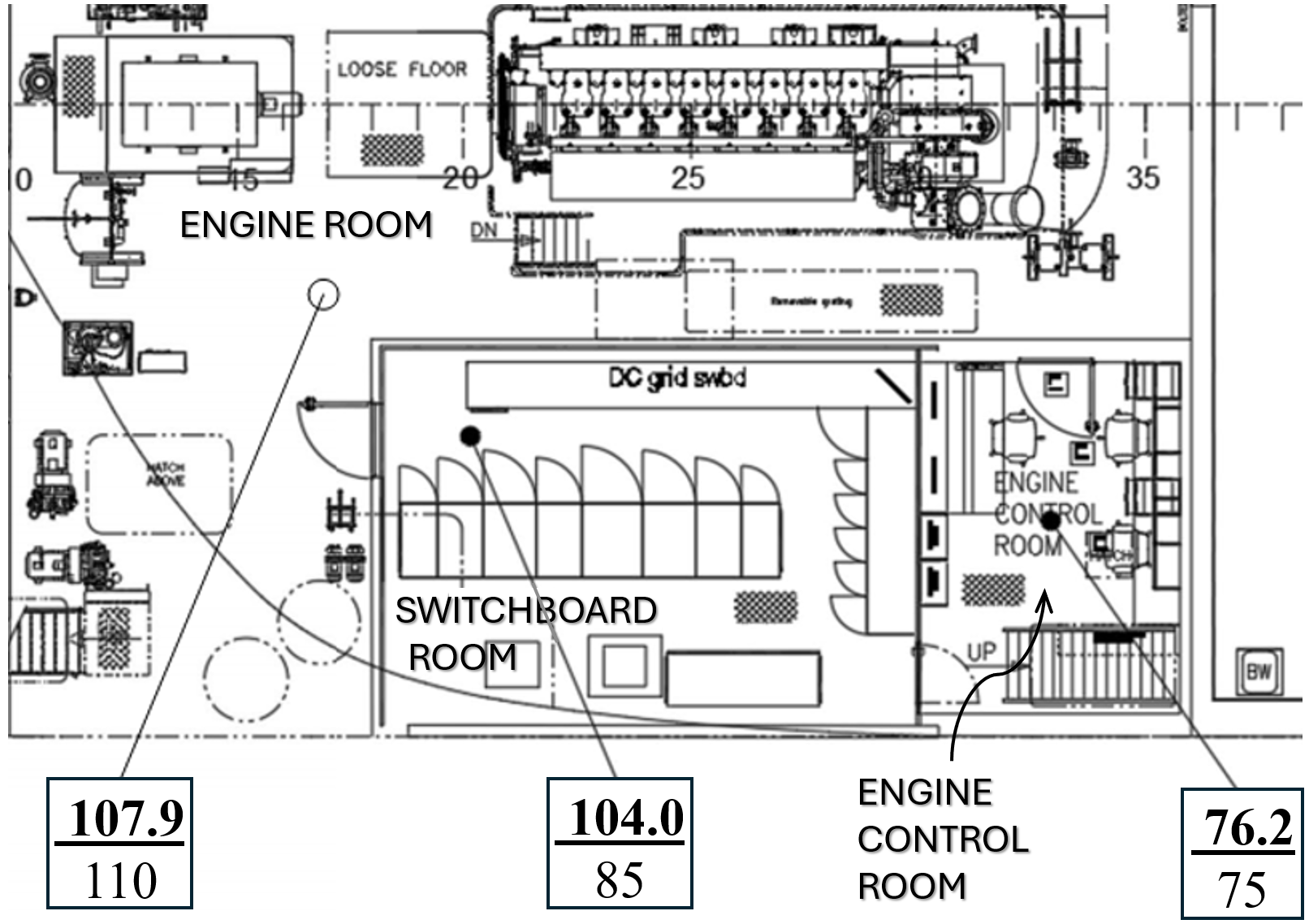
Fig. 4. Measured noise level in Engine Room, Switchboard Room and Engine Control Room compared to the permissible limits (107.9/110 dB(A), 104.0/85 dB(A) and 76.2/75dB(A))
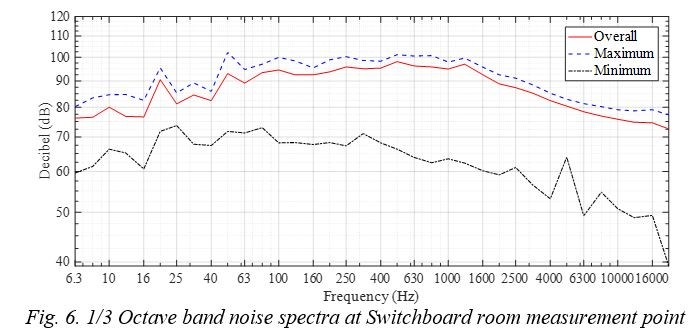
The analysis results generated by the G4 LD Utility software, together with the detailed measurement data, are compiled into individual reports for each measurement point (or measurement area). The report for the Galley (ship’s kitchen) measurement point was obtained through 1/3 Octave Band Analysis (OBA), as shown in Table 4, or in graphical form illustrating the distribution of sound pressure levels across each frequency component (see Fig. 5). The analysis further identifies the variation range of sound pressure levels within each frequency band, highlighting the differences between maximum, minimum, and overall spectra. Similar analyses were conducted for the remaining measurement points, such as the Switchboard room, as illustrated in Fig. 6.
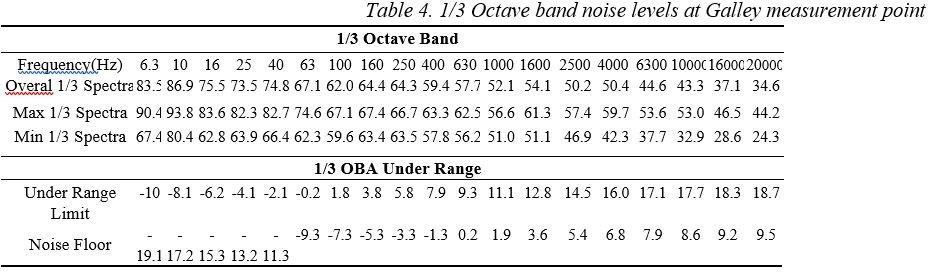
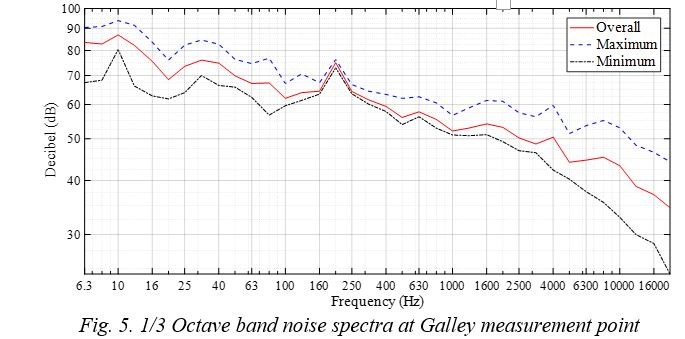
From the frequency band analysis results of the Galley measurement point, compared with the permissible noise limits in the octave bands specified in QCVN 24:2016/BYT [4], the values are presented in Table 5 as follows:
Table 5. Comparison of measured noise levels and permissible limits (QCVN 24:2016/BYT) at the Galley and Switchboard measurement points
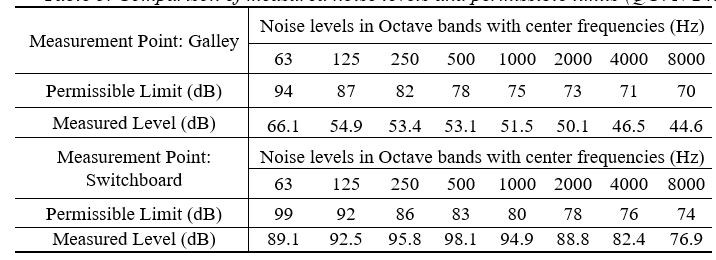
It was observed that the noise levels in the octave frequency bands at the Galley measurement point all complied with the QCVN 24:2016/BYT standard. However, the Switchboard room showed noise levels exceeding the permissible limits. The comparison results for other measurement points (control room, accommodation, medical room, gym, laundry room, mess room, etc.) were similar. Based on the shipboard noise standard MSC.337(91), only two measurement positions–the Switchboard room and the Engine Control Room–recorded noise levels above the allowable thresthold.
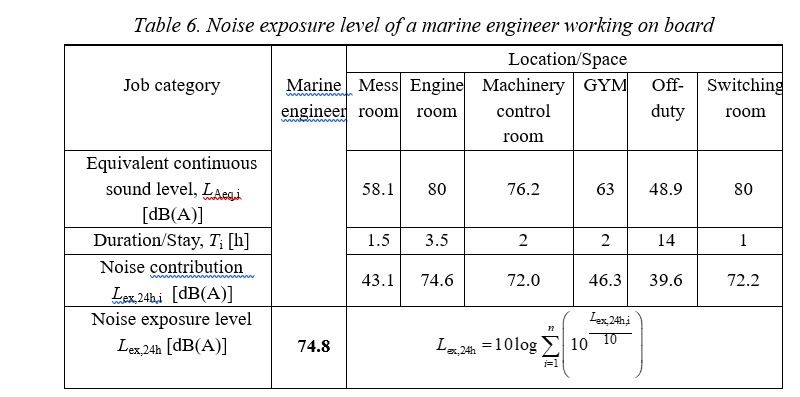
Overall, any individual on board may suffer hearing damage due to prolonged noise exposure, in other words, when the daily exposure level Lex, 24h exceeds 80 dB(A). In order to ensure that seafarers will not be exposed to this level, a simplified procedure for determining noise exposure is provided for determining the related noise exposure. Based on the noise report and the estimated working and off‑duty times for each job category, and using formulas (6) and (7), the noise exposure level can be calculated. Specifically, the daily noise exposure level of a marine engineer, based on a typical work schedule and duration, is presented in Table 6.
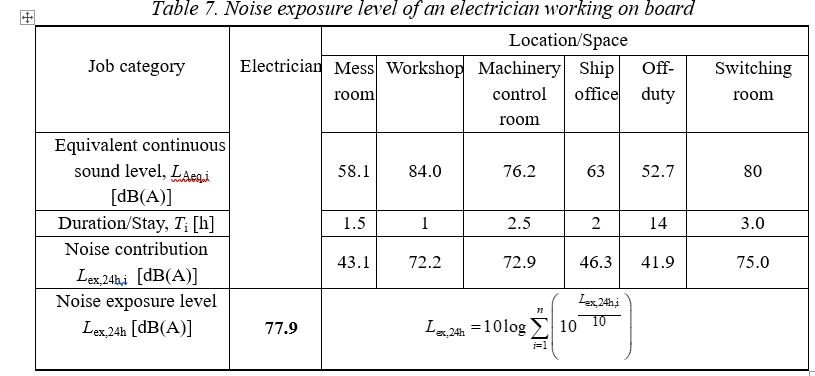
It is noted that the electrician’s daily occupational noise exposure, under the considered work shift, does not exceed the 80 dB(A) hearing‑damage threshold.
4. Conclusions
Noise control on ships relies on a structured process that includes measurement, analysis, and evaluation across different areas on board. Beyond comparing measured results with permissible limits at critical points of the vessel, it is also possible to assess the actual noise exposure of crew members and passengers. This dual approach provides a more complete understanding of onboard acoustic conditions and supports the preparation of a comprehensive noise report. Such a report is typically produced during the initial sea trials of a newly built ship, ensuring compliance with international standards and safeguarding occupational health.
The findings of this study provide a practical framework for evaluating noise levels and occupational noise exposure in line with established technical standards such as MSC.337(91), QCVN 24:2016/BYT, and ISO 9612:2009. In addition to serving as a benchmark for compliance, these results offer a solid technical basis for developing effective noise‑reduction solutions on both newly constructed and operating vessels. They also support the implementation of preventive measures in areas identified as high‑risk for noise exposure, thereby enhancing crew safety and passenger comfort.
Acknowledgements: This research is funded by Vietnam National University Ho Chi Minh City (VNU-HCM) under grant number C2025-20-08/HD-KHCN. We acknowledge the support of time and facilities from Ho Chi Minh City University of Technology (HCMUT), Vietnam National University - Ho Chi Minh City for this study. The research results were achieved through industrial projects conducted in collaboration between BKTECHS – Ho Chi Minh City University of Technology and VARD VUNG TAU LTD, Viet Nam.
Lê Đình Tuân 1,2*, Trần Văn Tạo 1,2,Đặng Vũ Bích Hạnh 1,2
1Ho Chi Minh City University of Technology (HCMUT), Vietnam
2Viet nam National University - Ho Chi Minh City (VNU-HCM), Vietnam
(The article was published on the Environment Magazine by English No. II/2026)
References
[1] Nguyen Hai, Acoustics and Noise Testing, Education Publishing House, 1997.
[2] RESOLUTION MSC.337(91) - Code on Noise Levels on Board Ships, IMO, 2012.
[3] IEC 61672-1:2002, Electroacoustics – Sound level meters, 2002.
[4] QCVN 24:2016/BYT, National Technical Regulation on Noise – Permissible Exposure Levels of Noise in the Workplace, 2016.
[5] ISO 9612:2009, Acoustics - Determination of occupational noise exposure: Engineering method.
[6] E. Rizzuto, A. Badino, D. Borelli, T. Gaggero, C. Schenonea. Noise emitted from ships: impact inside and outside the vessels. In Europe: Transport Reseach Arena, (2019).
[7] L. Picu, E. Rusu, M. Picu. An analysis of the noise in the engine room - case study a merchant ship navigating on Danube. In 19th SGEM Int’l Multidisciplinary Scientific GeoConference EXPO Proceedings, Romania, (2019).