
Abstract
This study investigates the intrinsic adsorption capability of pristine carbon nanofibers (pCNFs) derived from polyacrylonitrile (PAN) without traditional chemical activation. The pCNFs were synthesized via electrospinning from a 10 wt% PAN/DMAC solution using optimized parameters: an applied voltage of 18 kV, a flow rate of 0.3 mL/h, and a tip-to-collector distance of 9 cm. The resulting nanofibers were stabilized at 270°C and carbonized at 800°C under a nitrogen atmosphere. Material characterization confirmed a continuous 3D non-woven network with fiber diameters typically below 500 nm. Experimental results demonstrate that the unactivated pCNFs achieve a maximum Methylene Blue (MB) removal efficiency of approximately 30.0% at an optimal dosage of 25 mg within 120 minutes. The adsorption equilibrium data provided a superior fit to the Langmuir isotherm model (R2 = 0.9870), indicating a monolayer adsorption process on a relatively homogeneous surface. Kinetic analysis revealed that the process followed the pseudo-second-order model (R2 = 0.8369), suggesting that the rate-controlling step is governed by chemisorption mechanisms. These findings establish a foundational baseline for PAN-derived nanofibers, proving that the raw carbon framework possesses significant intrinsic potential for environmental remediation through cost-effective and green synthesis pathways.
Keywords: Carbon nanofibers, Electrospinning, Intrinsic adsorption, PAN-derived CNFs, Baseline performance, Methylene Blue, Adsorption kinetics, Wastewater treatment.
JEL Classification: Q51, Q52, Q53, Q55, Q56.
1. Introduction
The rapid expansion of global industrialization, particularly within the textile, paper, plastics, and printing sectors, has resulted in the massive discharge of highly toxic synthetic dyes into industrial effluents [1]. Among various classes of synthetic colorants, cationic dyes such as Methylene Blue (MB) are widely utilized. MB is a heterocyclic aromatic compound that possesses high stability against microbial degradation, light exposure, and chemical oxidation due to its complex conjugated structure [8]. The release of even trace concentrations of MB into natural water bodies dramatically reduces light penetration, thereby severely impeding the photosynthetic pathways of aquatic flora. Furthermore, long-term exposure to MB-contaminated water induces adverse health effects in humans, including severe respiratory distress, gastrointestinal irritation, cyanosis, and mutagenic mutations [10]. Consequently, developing highly efficient, economically feasible, and sustainable water treatment technologies is a matter of paramount environmental urgency.
Over the past few decades, various physicochemical techniques have been deployed for dye wastewater remediation, including advanced oxidation processes, membrane filtration, electrochemical degradation, and coagulation-flocculation [2]. However, most of these methodologies suffer from inherent drawbacks, such as excessive energy expenditure, high capital investment, operational complexity, and the hazardous generation of secondary toxic sludge. In contrast, liquid-phase adsorption has emerged as one of the most prominent strategies due to its operational simplicity, high flexibility, economic viability, and capability to capture diverse molecular pollutants even at low initial concentrations [5]. Industrial activated carbons represent the conventional benchmark for wastewater adsorption; nevertheless, their industrial scalability remains constrained by high regeneration costs and poor mechanical handling properties, which often require complex solid-liquid separation phases.
To address these limitations, one-dimensional (1D) carbon nanomaterials, specifically carbon nanofibers (CNFs) fabricated via electrospinning, have garnered intensive scientific attention [3]. Electrospun CNFs possess unique structural properties, including extremely high external geometric surface-area-to-volume ratios, high mechanical flexibility, and continuous 3D macroscopically interconnected porous webs. Unlike powdered activated carbons, electrospun CNFs form self-supported non-woven mats, eliminating the need for post-treatment centrifugation or filtration during mechanical separation from aqueous phases [7].
Polyacrylonitrile (PAN) is widely considered the premier precursor backbone for the mass synthesis of high-performance CNFs, owing to its exceptionally high carbon yield (exceeding 50%), outstanding structural stability, and its unique ability to undergo thermal cyclization into a highly stable heteroaromatic ladder polymer infrastructure [9].
A critical review of current literature indicates that a significant majority of research endeavors focus heavily on optimizing the performance of CNFs through intensive post-synthetic modifications. These typically involve harsh chemical activation regimes using corrosive chemical agents such as potassium hydroxide KOH, sodium hydroxide NaOH, or concentrated phosphoric acid H3PO4 at elevated temperatures to aggressively create artificial micropores [12]. While these activation methods significantly augment the specific surface area, they severely degrade the continuous mechanical integrity of the carbon nanofiber mat, causing it to become brittle and prone to structural collapse. Furthermore, the massive consumption of chemical activators introduces new eco-toxicological challenges, generating secondary acidic or alkaline hazardous chemical waste.
Interestingly, very few studies have systematically isolated, analyzed, and articulated the intrinsic adsorption capabilities of pure, unactivated PAN-derived CNFs (pCNFs). Pristine, unactivated carbon frameworks naturally contain structural defects, localized edge active spots, and crucially native nitrogen atoms natively inherited from the nitrile groups
While most contemporary research focuses on enhancing performance through harsh chemical activation (e.g., using KOH or H3PO4), understanding the intrinsic adsorption potential of the raw carbon framework is essential for developing sustainable and low-cost treatment technologies. Pristine CNFs (pCNFs) offer a unique 3D non-woven network with high external surface accessibility and inherent surface polarity. This study aims to evaluate the baseline performance of pCNFs, providing critical insights into the chemical and structural factors that drive dye capture before any external functionalization is applied.
2. Experimental Methodology
2.1. Materials and Chemicals
Polyacrylonitrile (PAN, Average Molecular Weight 150,000 g/mol) was procured in high purity to serve as the structural polymer matrix. Industrial grade n,n-Dimethylacetamide (DMAC,
2.2. Synthesis of Unactivated Carbon Nanofibers (pCNFs)
The production of pristine unactivated carbon nanofibers involved three sequential thermal processing operations: solution formulation, electrospinning, thermal stabilization, and inert carbonization [11].
- Solution Preparation: A precise 10 wt% polymer dopes solution was formulated by dissolving solid PAN powder into DMAC solvent under continuous magnetic stirring overnight until a perfectly clear, homogeneous, viscous solution was attained.
- Electrospinning Process: The prepared PAN solution was transferred into a standard plastic syringe equipped with a stainless-steel capillary needle. The electrospinning apparatus was configured with optimized baseline variables: an acceleration high-voltage supply of 18 kV, a constant solution volumetric flow rate of 0.3 mL/h, and a needle-to-collector distance fixed at 9 cm. The resulting continuous polymeric non-woven nanofiber mats were collected on an aluminum foil sheet.
- Thermal Stabilization: The raw electrospun PAN nanofiber mats were placed into a high-temperature box furnace for oxidative stabilization. The temperature was raised from ambient levels to 270oC using a controlled heating rate of 5oC/min The sample was held at 270 oC for exactly 2 hours and 15 minutes under an atmospheric air flow. This stage allowed the linear PAN chain molecules to undergo cyclization, dehydrogenation, and oxidation, converting them into a non-fusible heteroaromatic ladder structure capable of withstanding subsequent high-temperature treatment.
- Carbonization: The stabilized fiber mats were subsequently positioned inside a horizontal tube furnace. The environment was thoroughly purged with high-purity nitrogen gas (99.99%) at a steady flow rate of 200 mL/min to guarantee a completely oxygen-free atmosphere. The temperature was ramped up to 800oC and maintained for a dwell duration of 2 minutes to induce rapid carbonization, which expelled volatile non-carbon components and yielded the final unactivated pure carbon nanofibers (pCNFs).
2.3. Characterization Techniques
The surface morphology and microscopic structural configurations of both the precursor and carbonized nanofibers were examined via Scanning Electron Microscopy (SEM). The elemental composition of the carbon fiber network was quantified using Energy Dispersive X-ray Spectroscopy (EDX). The evolution of surface functional groups and chemical transitions was confirmed via Fourier Transform Infrared Spectroscopy (FTIR) over the wavenumber spectrum of -4000 to -500 cm-1.
2.4. Batch Adsorption Experiments
Liquid-phase batch adsorption evaluations were systematically conducted using a mechanical orbital shaker operating at a constant velocity from 200 to 230 rpm under ambient temperature. The standard aqueous volume for each experimental run was fixed at 20 mL, with an initial baseline MB dye concentration set at 2 mg/L.
- Effect of Adsorbent Dosage: To investigate mass optimization, variable quantities of unactivated pCNFs mats were added to individual dye flasks: 10, 15, 20, 25, and 30 mg.
- Effect of Contact Time: Kinetic parameters were resolved by tracking the adsorption progress over discrete temporal intervals: 15, 30, 60, 90, and 120 minutes.
Following each specific contact interval, the nanofiber mat was separated from the solution. The residual equilibrium concentration of MB was determined using a UV-Vis Spectrophotometer at its maximum characteristic wavelength (

where A represents the measured optical absorbance unit and x denotes the precise MB concentration (mg/L).
The equilibrium adsorption capacity (


3. Results and Discussion
3.1. Material characterization
Scanning electron microscopy analysis of the synthesized materials confirmed the successful formation of a structurally stable, uniform, and bead-free one-dimensional nanostructural network. The raw electrospun PAN precursor fibers appeared continuous, smooth, and randomly oriented (Figure 3.1a). Following oxidative stabilization and high-temperature carbonization at 800oC, the pCNFs retained their continuous 3D non-woven fibrous framework without experiencing structural collapse, melting, or severe fiber fusing.


Figure 3.1. Scanning electron microscopy (SEM) images of the optimized fiber sample: (a) PAN precursor fiber before heat treatment and (b) Carbon nanofiber (CNF) after carbonization.
Due to the rapid volatilization of non-carbonaceous species and subsequent cross-linking density compaction, a minor radial shrinkage was observed, yielding ultra-fine fiber diameters tightly distributed within the 200 - 250 nm range. This nanoscale diameter provides a high external geometric boundary layer, offering short radial mass-transfer pathways that allow organic dye molecules to rapidly access surface active sites (Figure 3.2).

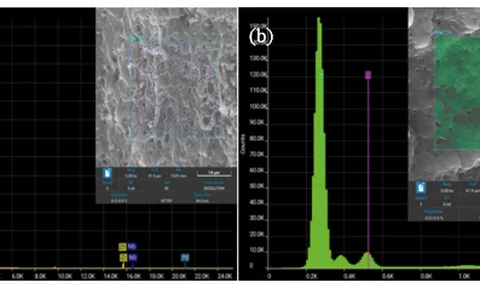
Elemental analysis via EDX (Table 3.1 and Figure 3.4), quantitative EDX analysis confirmed that the non-activated pCNF mat was primarily composed of Carbon (>88%) and Oxygen (>10%), along with trace baseline mineral elements (Na, Zr, Nb, Pd). The presence of these heteroatoms contributes to the material's surface polarity, facilitating interactions with cationic dyes.
Table 3.1. Quantitative EDX elemental composition of pCNFs at various scales.
|
Scale |
Element |
Weight (%) |
Atomic (%) |
|
2
(Figure 3.4a) |
Carbon (C) Oxygen (O) Zirconium (Zr) |
86.25 13.31 0.44 |
89.57 10.37 0.06 |
|
10 (Figure 3.4b)
|
Carbon (C) Oxygen (O) Sodium (Na) Niobium (Nb) Zirconium (Zr) Palladium (Pd) |
83.86 14.75 0.38 0.99 0.01 0.01 |
88.03 11.62 0.21 0.13 0.00 0.00 |
|
100 (Figure 3.4c)
|
Carbon (C) Oxygen (O) Niobium (Nb) Palladium (Pd) |
86.07 12.81 1.12 0.08 |
89.77 10.06 0.15 0.01 |

Futhurmore, the structural transitions occurring during carbonization were verified by FTIR spectroscopy. The FTIR spectra of pCNFs in Figure 3.3 showed a prominent diagnostic peak at 1582 cm-1 which corresponds directly to the characteristic C=C stretching vibration within aromatic ring configurations C=C stretching in graphitic aromatic domains, which is vital for providing

3.2. Intrinsic adsorption performance of pCNFs
The liquid-phase removal efficiency of Methylene Blue (MB) by the pristine carbon nanofibers (pCNFs) was found to be highly dependent on both the adsorbent dosage and contact time. From figure 3.4 and 3.5, it is showing at a fixed initial MB concentration of 2 mg/L, increasing the pCNF dosage from 10 mg to 25 mg resulted in a steady enhancement of the overall removal efficiency, peaking at approximately 30.0% for the 25 mg dosage within 120 minutes.


This upward trend is primarily attributed to the increased total external surface area and the greater abundance of active binding sites, such as graphitic edge planes and native nitrogen nodes, available for dye capture. However, when the dosage was further increased to 30 mg, the removal efficiency did not show additional improvement and instead stabilized to approximately 25 - 28%. This phenomenon indicates that excessive fiber concentration within a fixed volume leads to partial overlapping and local bundle aggregation. Such packing effects within the non-woven 3D web effectively "shield" internal active sites from the liquid phase, thereby reducing the effective surface area available for interaction with MB cations.
Temporal tracking across all dosages revealed a rapid initial uptake during the first 15 to 60 minutes, a phase driven by the high availability of vacant surface active sites. As these primary sites approached saturation, the adsorption rate transitioned into a slower phase governed by surface diffusion and site occupancy. The system eventually reached a flat equilibrium plateau between 90 and 120 minutes, indicating that the pCNFs had reached their intrinsic capacity under the investigated conditions. These results suggest that 25 mg represents the optimal dosage for maximizing the intrinsic performance of the unactivated carbon framework.
3.3. Adsorption Isotherms and Kinetics
To understand the interaction mechanisms between the solute dye molecules and the non-activated carbon framework, the experimental data were fitted to linear Langmuir and Freundlich isotherm models. As shown in figure 3.6, the Langmuir model demonstrated a strong fit with an outstanding correlation coefficient (R2 = 0.9870), confirming that the adsorption process on the pCNFs follows a homogeneous monolayer mechanism. This indicates that each active site on the fiber wall accommodates only a single dye molecule, and no further adsorption occurs once a site is occupied.

And as a methodological note on parameter anomalies, the linear fitting yielded a highly inflated theoretical maximum Langmuir capacity parameter (QL = 2000 mmol.g-1) and a negative Freundlich intensity exponent (bF = -1.396) showing in table 3.2. In a rigorous academic context, these highly skewed values do not imply infinite capacity. Rather, they reflect the limitations of the narrow experimental concentration range (2 mg/L) and the limited number of discrete data points used during batch evaluation. This demonstrates that while the non-activated framework follows monolayer adsorption dynamics, higher initial concentration profiles are needed to fully saturate the material and resolve precise thermodynamic boundaries.
Table 3.2. Comparison of Langmuir and Freundlich isotherm parameters for methylene blue adsorption onto pCNFs samples at 120 min
|
Sample |
Langmuir R² |
QL (mmol g⁻¹) |
KL (L mmol⁻¹) |
Freundlich R² |
KF (mmol g⁻¹) |
bF |
|
Non-activated CNFs |
0.9870 |
2000 |
0.0877 |
0.9884 |
4.9 × 10⁶ |
−1,396 |
Kinetic data were modeled using pseudo-first-order (PFO) and pseudo-second-order (PSO) linear models. The correlation coefficients favored the PSO model (R2 = 0.8369) showing in Figure 3.8 over the PFO model (R2 = 0.8363) showing in Figure 3.7. This agreement with pseudo-second-order kinetics demonstrates that the rate-limiting step of MB capture onto the pCNFs is governed by surface chemisorption interactions involving valence forces or electron sharing, rather than simple physical film boundary layer diffusion. The non-activated pCNFs exhibited high kinetic rate constants (K2 = 7.20 g.mmol-1.min-1) showing in Table 3.3, indicating rapid surface capture dynamics due to the open, unobstructed 1D external fiber geometry.


Table 3.3. Pseudo-second-order kinetic parameters for methylene blue adsorption onto pCNFs
|
Sample |
Equation |
Qe calculated (mmol g⁻¹) |
K2 (g mmol⁻¹ min⁻¹) |
R2 |
|
Non-activated CNFs |
y = 234.8x + 11510 |
0.00426 |
7.20 |
0.8369 |
3.4. Proposed Intrinsic Adsorption Mechanism
To fully understand why the completely non-activated pCNF framework can achieve an autonomous removal performance of ~30% without any chemical activation, it is necessary to examine the molecular interactions occurring at the liquid-solid interface. The intrinsic capture mechanism is driven by three synergistic pathways:
3.5.1. Aromatic
Methylene Blue is an aromatic heterocyclic chemical compound containing highly delocalized
When the flat MB molecules approach the continuous, unhindered outer surfaces of the carbon nanofibers, strong non-covalent
3.5.2. Electrostatic Attraction via Native Nitrogen Matrix Nodes
A key advantage of utilizing polyacrylonitrile (PAN) as the polymer precursor is its inherent molecular structure, which contains a high density of nitrile groups (
These natively embedded nitrogen heteroatoms possess lone pairs of electrons, which induce a localized negative charge density across the carbon fiber walls. Because Methylene Blue dissociates in aqueous solutions into a positively charged cationic dye monomer (MB+), strong electrostatic attractions are naturally generated between the natively electronegative nitrogen nodes on the pCNF surface and the cationic dye molecules. This facilitates rapid chemical capture, as supported by the pseudo-second-order kinetic data.
3.5.3. Interconnected 1D Macro-Transport and Physical Trapping
From a structural perspective, the electrospun pCNFs form a continuous, three-dimensionally interwoven non-woven porous network. The ultra-fine diameter distribution (200 - 250 nm) ensures a high external geometric surface area that is fully accessible to the aqueous solution. This open structure eliminates the internal pore-diffusion resistance typically encountered in granular or powdered activated carbons, where active sites are buried deep within complex tortuous micro-channels.
The nanoscale surface roughness, microscopic structural defects, and interconnected macro-voids between intersecting fibers act as physical traps that accommodate migrating dye molecules. Once the dye is drawn close by electrostatic forces, it becomes immobilized within these surface features. This continuous, open structure explains the high kinetic rate constant (K2 = 7.20 g.mmol-1.min-1) as the dye molecules can interact directly with the external fiber surfaces without encountering internal mass-transfer resistance.
4. Conclusions and Recommendations
This study successfully evaluated the intrinsic adsorption capabilities of pure, pristine PAN-based carbon nanofibers (pCNFs) synthesized via optimized electrospinning and controlled thermal processing (800oC carbonization). Characterization confirmed that the material maintained a structurally robust, continuous, 3D non-woven network of ultra-fine fibers (200 - 250 nm) with a highly graphitized structure.
Batch adsorption testing demonstrated that the pCNFs could achieve an optimized MB dye removal efficiency of approximately 30% at a mass dosage of 25 mg within 120 minutes. Equilibrium data fitted the Langmuir isotherm model (
The intrinsic performance of the pCNFs is driven by a combination of
These results demonstrate that raw, non-activated carbon nanofibers can serve as efficient, standalone framework adsorbents. By eliminating the need for corrosive chemical activation treatments, this approach reduces chemical consumption and secondary waste generation, offering a sustainable alternative for industrial wastewater remediation.
Future research should incorporate Brunauer-Emmett-Teller (BET) surface area analysis to accurately correlate pore structures with capacity profiles. Additionally, expanding the initial concentration ranges and evaluating performance in multi-pollutant systems will help optimize these non-activated fiber networks for large-scale environmental engineering applications.
Acknowledgements
The authors acknowledge the Faculty of Environment and Natural Resources, Ho Chi Minh City University of Technology (HCMUT), Vietnam National University Ho Chi Minh City (VNU-HCM), Department of Environmental Engineering & Innovation and Development Center of Sustainable Agriculture, National Chung Hsing University, Taichung, Taiwan for providing laboratory facilities and research support.
Liao Jui Pin1,2, Du Thuc Nhi1,2, Kun-Yi Andrew Lin3, Le Thi Huynh Tram1,2, Dang Vu Bich Hanh1,2*
1 Faculty of Environment and Natural Resource, Ho Chi Minh City University of Technology (HCMUT),
2 Vietnam National University-Ho Chi Minh City (VNU-HCM)
3 Department of Environmental Engineering & Innovation and Development Center of Sustainable Agriculture, National Chung Hsing University, Taichung, Taiwan
References
1. Al-Tohamy, R., Ali, S. S., Li, F., Khan, K. M., Mahmoud, Y. A. G., Mushtaq, M., ... & Jianzhong, S. (2022). A critical review on textile dyes, toxicity of dyes and dye-decolorizing enzymes to mitigate the environmental pollution. Environmental Research, 212, 113196.
2. Crini, G. (2006). Non-conventional low-cost adsorbents for dye removal: a review. Bioresource Technology, 97(9), 1061-1085.
3. Inagaki, M., Yang, Y., & Kang, F. (2014). Advanced Materials Science and Engineering of Carbon. Butterworth-Heinemann.
4. Kielbassa, S., Burger, J., & Griebel, A. (2014). Structural evolution of polyacrylonitrile precursors during carbonization. Journal of Applied Polymer Science, 131(12), 404-415.
5. Kyzas, G. Z., & Matis, K. A. (2015). Nanoadsorbents for water remediation: a review. Journal of Molecular Liquids, 203, 159-168.
6. L. V. Cát, “Hấp phụ và trao đổi ion trong kỹ thuật xử lý nước thải”, Hà Nội: NXB Thống kê, 2002
7. Natraj, S. K., Yang, K. S., Bajaj, H. C., & Shukla, P. S. (2007). Polyacrylonitrile-based electrospun carbon nanofibers for environmental applications. Journal of Environmental Management, 84(3), 320-327.
8. Rafatullah, M., Sulaiman, O., Hashim, R., & Ahmad, A. (2010). Adsorption of methylene blue on low-cost adsorbents: a review. Journal of Hazardous Materials, 177(1-3), 70-80.
9. Rahaman, M. S. A., Ismail, A. F., & Mustafa, A. (2007). A review of heat treatment on polyacrylonitrile-based carbon fibers. Polymer Degradation and Stability, 92(8), 1421-1432.
10. Srinivasan, A., & Viraraghavan, T. (2010). Decolorization of dye wastewaters by biosorbents: a review. Journal of Environmental Management, 91(10), 1912-1929.
11. Wang, C., Cheng, P., Yao, Y., Yamauchi, Y., Yan, X., Li, J., & Na, J. (2020). In-situ fabrication of nanoarchitectured MOF filter for water purification. Journal of Hazardous Materials, 392, 122164. https://doi.org/10.1016/j.jhazmat.2020.122164
12. Zhu, J., Jin, C., & Zhang, X. (2014). Electrospun carbon nanofibers and their activation processes for advanced environmental remediation. Carbon, 70, 12-26.