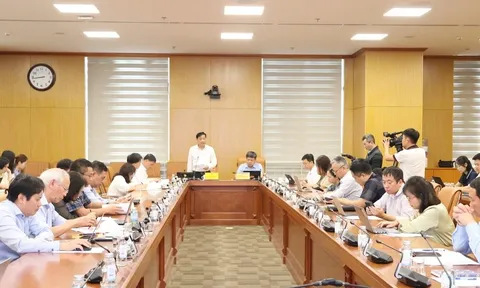

The workshop “Economic and Financial Analysis of Low-Emission Rice Production Practices in the Mekong Delta” was held on the morning of April 24, 2026, at Novotel Suites Hanoi, No. 5 Duy Tan Street, Cau Giay District, Hanoi.
The Institute of Strategy and Policy on Agriculture and Environment, in collaboration with the World Bank Group, conducted the study entitled “Economic and financial analysis of low-carbon rice production in the Mekong River Delta”. The study aimed to assess the economic and financial performance of low-carbon rice production models implemented under the Viet Nam Sustainable Agriculture Transformation Project (VnSAT) and the Program on “Sustainable Development of One Million Hectares of High-Quality, Low-Emission Rice Specialization Associated with Green Growth in the Mekong Delta by 2030” (OMHP).
At the workshop, the study findings were presented, along with discussions on policy mechanisms to promote the transition of rice production systems toward sustainability, low emissions, and climate resilience in the Mekong River Delta (MRD).
The workshop was attended by Mr. Tran Cong Thang, Director of the Institute of Strategy and Policy on Agriculture and Environment; Mr. Li Guo, Senior Agricultural Economist from the World Bank Group; representatives from departments under the Ministry of Agriculture and Environment; representatives from provincial Departments of Agriculture and Environment in MRD provinces participating in the program (An Giang, Can Tho, and Dong Thap); as well as international organizations such as the Food and Agriculture Organization of the United Nations (FAO), the International Rice Research Institute (IRRI), and various associations and enterprises.
At the workshop, Dr. Tran Cong Thang highlighted the context in which Viet Nam is promoting agricultural transformation, particularly in the rice sector, toward green, sustainable, and low-emission practices to fulfill its commitment to achieving net-zero emissions by 2050, while enhancing competitiveness in international markets. The rice sector is under increasing pressure from global environmental standards and traceability requirements, necessitating comprehensive changes from production to policy. The Government has implemented several key initiatives, notably the OMHP in the MKD, with technical support from international organizations such as the World Bank Group. However, scaling up requires stronger evidence on economic and financial effectiveness, as well as conditions for replication. At the workshop, he presented research findings showing that households participating in the VnSAT or OMHP have achieved improvements in farming practices, including reduced seed use, lower pesticide application, and initial economic gains compared to non-participating households. He also discussed barriers to transitioning toward low-emission rice production, as well as enabling factors for its development in the MRD.
Participants acknowledged and highly appreciated the study’s economic and financial results in quantifying the economic benefits of transitioning to low-emission rice farming. These quantitative findings provide an important basis for policymaking and scaling up the model in practice.
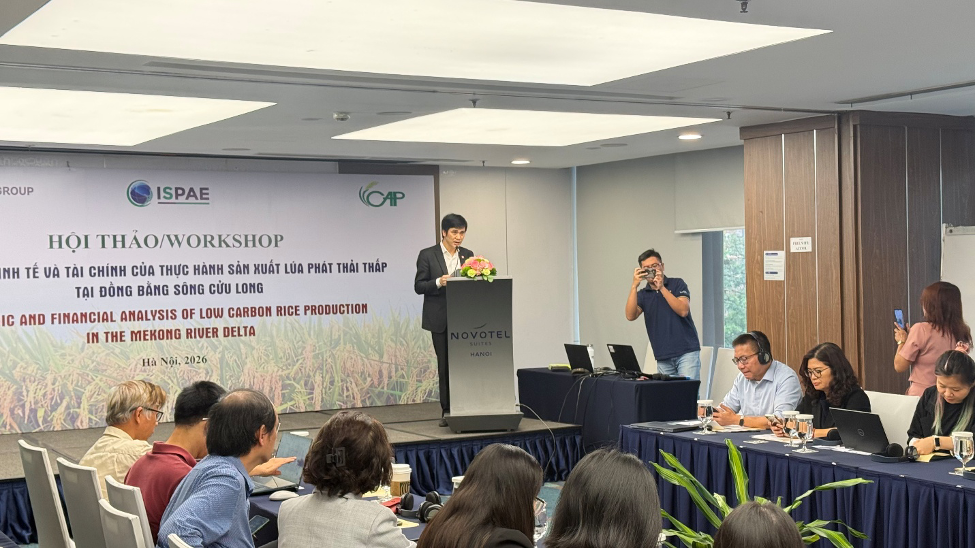
Dr. Dang Kim Son, former Director of the Institute of Policy and Strategy for Agriculture and Rural Development, emphasized the need to strengthen and refine institutional and policy mechanisms to enhance the role of cooperatives in the rice value chain. Although cooperatives have made notable progress with support from the VnSAT, it remains necessary to further improve their capacity in service provision, particularly in technical services, input supply, and market linkages. To drive a sustainable transition toward low-emission rice production, it is essential to clarify and promote the role of the private sector, while strengthening the participation of rice industry associations. These actors play a key role in communication, advocacy, and market development for low-emission rice products, thereby contributing to increased product value, higher export prices, and the promotion of Vietnam’s low-emission rice production image in international markets.
Prof. Assoc. Dr. Dao The Anh, President of Viet Nam Rural Development Science Association (PHANO), raised the issue of protecting the “low-emission rice” brand and proposed expanding research to fully account for all costs in rice production, particularly those related to natural resources and the environment. In addition, experts and participants discussed challenges in straw collection and treatment, cooperative management capacity, infrastructure, access to credit for farmers, and existing constraints in low-emission rice certification. They emphasized the need to strengthen technology adoption, develop value chains and markets (including carbon markets), and enhance the roles of the State, enterprises, and cooperatives to ensure the long-term effectiveness of the program.