
11/12/2025
Abstract
The article analyzes the current situation and solutions to control air pollution in Thailand, in the context of increasingly serious PM2.5 dust in major cities such as Bangkok, Chiang Mai and Khon Kaen. The main causes come from traffic, industry, agricultural burning and forest fires, combined with the phenomenon of temperature inversion causing pollution to accumulate at low levels. In this situation, Thailand has synchronously deployed many solutions: applying strict emission standards, flexible traffic adjustment, expanding automatic monitoring systems, using satellite data and artificial intelligence, developing the Air4Thai application to provide real-time air quality information. At the same time, Thailand also promotes the legal framework through the "Clean Air" Bill, strengthens public education and communication, and international cooperation to control cross-border pollution. Experiences from Thailand demonstrate the importance of cross-sectoral governance, technology investment and social engagement in efforts to build clean air and sustainable development.
JEL Classifications: P18, P48, Q53.
The rapid pace of urbanization in Thailand has precipitated a range of environmental challenges, among which air pollution has emerged as one of the most pressing concerns. Major urban centers across the country are consistently ranked among the cities with the most severe levels of air pollution globally. Particularly alarming is the concentration of fine particulate matter (PM2.5), which regularly exceeds the safety thresholds recommended by the World Health Organization (WHO). Such elevated levels of air pollutants pose profound risks to public health and significantly degrade the overall quality of life for urban populations.
In Bangkok, the capital city and Thailand’s primary economic hub, air pollution has become a persistent and recurrent issue, situating the metropolis among the global cities with the poorest air quality. One of the leading sources of this problem is urban transportation, given the city’s population of over 10 million and the exceptionally high density of private vehicles. Statistical data indicate that nearly 60% of total air pollution in Bangkok originates from road traffic emissions, particularly from vehicles powered by fossil fuels, such as motorcycles and aging diesel cars. Industrial operations and large-scale construction activities, which often proceed with limited environmental oversight, further exacerbate the emission of fine particulate matter. The problem intensifies during the dry season due to the increasingly frequent occurrence of atmospheric temperature inversions. Under normal conditions, warmer air near the ground rises and disperses pollutants upward, thereby reducing their concentration at ground level. However, during inversion events, colder air is trapped near the surface while warmer air layers settle above; creating an invisible “lid” that prevents the vertical dispersion of pollutants. Consequently, vehicular and industrial emissions accumulate in the lower atmosphere, leading to rapid and severe deterioration of air quality.
In the northern region of the country, Chiang Mai - an internationally renowned tourist destination faces a different yet equally critical form of air pollution, primarily driven by agricultural burning and forest fires. During the dry season, which typically spans from February to April, the widespread practice of burning rice straw and post-harvest residues, deeply rooted in traditional agricultural methods, generates vast amounts of smoke and fine particulate matter that blanket the region. Concurrently, recurrent forest fires further aggravate pollution levels, frequently pushing PM2.5 concentrations into hazardous ranges. The mountainous terrain and dry climatic conditions hinder the dispersal of these pollutants, resulting in prolonged episodes of toxic haze. This not only jeopardizes community health but also inflicts significant economic losses, particularly within the tourism sector, which is a cornerstone of Chiang Mai’s economy.
Similarly, in Khon Kaen, the largest urban center in northeastern Thailand, air pollution has been escalating at an alarming rate. The city is subjected to a dual burden: locally generated emissions from rapid urbanization and heavy intra-urban traffic, as well as transboundary haze originating from cross-border agricultural burning. During the dry season, PM2.5 concentrations in Khon Kaen frequently surpass 70 - 80 µg/m³, with levels spiking dramatically on days when seasonal winds blow southward from the northern region. Compounding the problem, the city’s air quality monitoring infrastructure remains underdeveloped, thereby limiting the capacity for early warning and effective pollution management. Khon Kaen serves as a telling example of how secondary urban centers, though not classified as megacities, are increasingly being drawn into the vortex of air pollution as a consequence of rapid development and regional environmental dynamics.
In general, localities in Thailand are facing PM2.5 dust pollution at different levels (Table 1).
|
Region |
Trend in 2025 |
Key Characteristics |
|
17 Northern provinces |
Gradual increase, frequently exceeding thresholds |
Strong fluctuations from mid-February |
|
Bangkok and surrounding areas |
Slight decrease but still high |
Multiple exceedance episodes in late December & January |
|
Northeastern region |
Noticeable increase compared to 2024 |
Noisy data, frequent touches/exceedances of the red threshold |
|
Central region |
Slight decrease compared to 2024 |
Several peaks exceeding thresholds in January & February |
|
Western region |
Similar to the North, frequent threshold exceedances |
Numerous episodes of extremely high PM2.5 levels in February |
(Source: PCD Thailand)
2. Synchronous solutions for air quality management
In response to the escalating problem of air pollution, Thailand has recognized the urgent need for a comprehensive air management strategy that integrates cross-sectoral coordination and is closely linked to the transition toward sustainable urban development. Central to this strategy is the implementation of synchronized and multidimensional pollution control measures.
First, Thailand has sought to harmonize policies aimed at emission reduction with stringent monitoring of transportation and industrial activities. On the policy front, the government has issued regulations targeting two primary sources of emissions: transport and industry. Specifically, the mandatory adoption of Euro 5 emission standards for all newly registered vehicles has been enforced, while restrictions have been imposed on the operation of older diesel-powered vehicles within central urban areas. In parallel, Thailand has introduced flexible regulatory mechanisms, adjusting the operation of transportation and industrial activities both spatially and temporally, particularly during adverse meteorological conditions such as thermal inversions or stagnant winds, in order to mitigate pollutant accumulation. The establishment of Low Emission Zones, restructuring of public transport systems, and promotion of electric vehicle usage have significantly contributed to the reduction of urban emissions. Within industrial zones, factories are compelled to comply with emission licensing requirements, while businesses are encouraged to adopt cleaner production technologies and renewable energy sources.
Second, decisive policies have been introduced to strengthen multi-sectoral coordination mechanisms at both the central and local levels. A key milestone in this regard is the drafting of the “Clean Air Act,” designed to set concrete air quality standards while establishing strict regulatory frameworks for major emission sources, including transportation, industry, and agriculture. The draft law also proposes administrative penalties of up to 50,000 baht (approximately 40 million VND) for violations, underscoring the government’s firm stance in addressing polluters and enforcing compliance.
Third, Thailand has invested substantially in the expansion of its nationwide automatic air quality monitoring system, integrating satellite data and digital technologies. This effort encompasses several key components:
(i) The Air Quality Monitoring Network (AQMN) has been expanded nationwide, deploying advanced sensors to collect real-time data on key pollutants such as PM2.5, PM10, NO₂, SO₂, CO, and ozone. The data are synchronized and made publicly available in real time.
(ii) An early warning system and mobile application, Air4Thai, developed by the Pollution Control Department (PCD), provides air quality information to the public, enabling precautionary measures. The system also issues automated alerts when the Air Quality Index (AQI) exceeds hazardous levels, allowing citizens to track real-time air quality and receive safety alerts.
(iii) The integration of satellite data from NASA’s Fire Information for Resource Management System (FIRMS) with artificial intelligence enables the detection of hotspots resulting from crop residue burning and forest fires. AI technologies are also employed to forecast pollution trends by region and time.
(iv) The establishment of a National Environmental Air Data Portal as an open-access platform provides government agencies, researchers, and the general public with comprehensive environmental datasets, thereby fostering transparency and accountability in air quality governance.
Through these enhanced monitoring and technological innovations, authorities are better equipped to implement timely mitigation measures, such as temporarily halting dust-generating construction projects, restricting open burning, or redirecting traffic flows in areas experiencing critical levels of pollution.
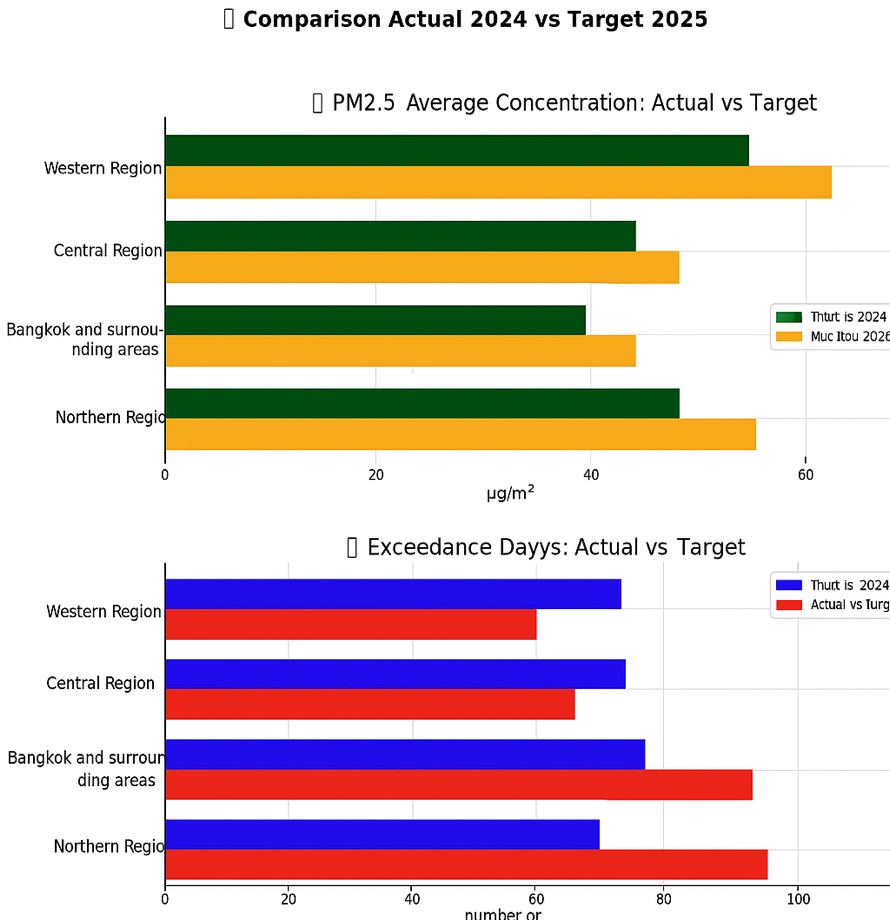
Air quality comparison chart in Thailand, showing efforts to reduce average PM2.5 dust concentrations and reduce the number of days exceeding pollution standards in regions of Thailand in 2025 compared to the situation in 2024. (Source: PCD Thailand)
Fourth, Thailand has implemented a wide range of communication and educational campaigns aimed at raising public awareness of air pollution. A notable example is the nationwide campaign “Clean Skies for the Future of Our Children”, which has garnered participation from diverse social groups, ranging from Buddhist monks and artists to school pupils and university students. In addition, community-based educational initiatives such as workshops and extracurricular environmental classes are regularly organized in schools and local communities. These efforts seek to instill early awareness among younger generations about the importance of protecting clean air and fostering long-term behavioral change.
Fifth, Thailand has established a comprehensive legal framework and strengthened international cooperation. The adoption of the “Clean Air Act” represents a significant milestone in the country’s environmental policy, with a focus on enhancing monitoring systems, raising emission standards, and addressing air pollution from both domestic and transboundary sources. At the regional and global levels, Thailand actively participates in cooperative initiatives such as the ASEAN Agreement on Transboundary Haze Pollution and the Regional Action Programme on Air. These initiatives highlight Thailand’s clear political commitment and its increasingly proactive role in the fight against air pollution in Southeast Asia.
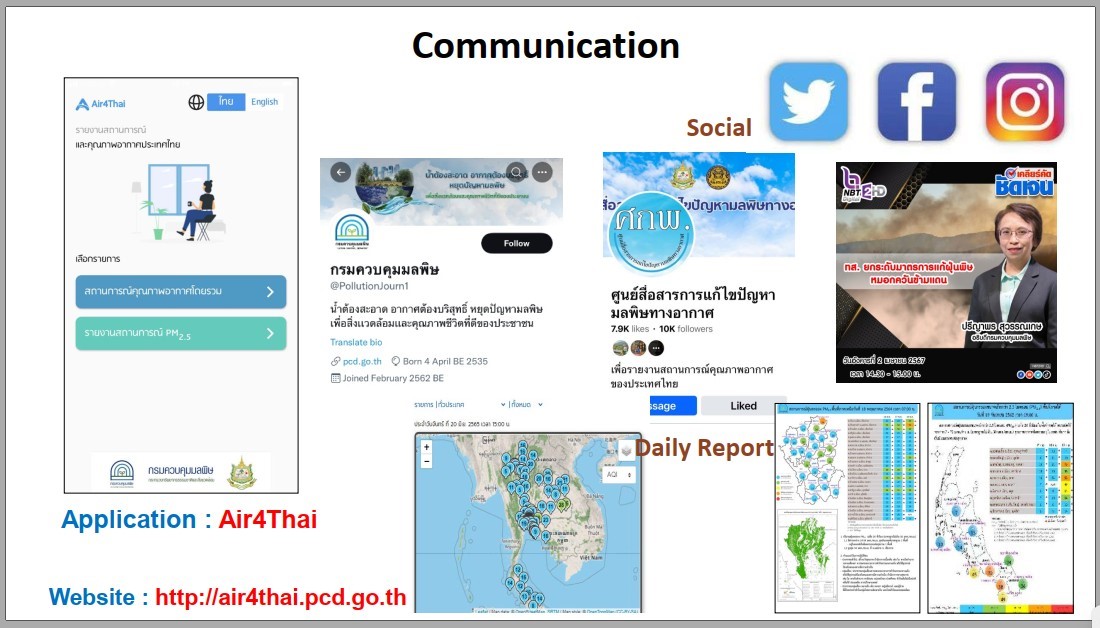
Air4Thai application and multi-platform communication system (website, social media, daily reports) to update PM2.5 dust situation, raise public awareness and support quick decision making (Source: PCD Thailand).
3. Conclusion
From the positive developments in Thailand’s efforts to control air pollution, several key orientations can be drawn to inform practical approaches to air quality management. First and foremost, it is essential to establish a comprehensive legal framework for clean air, one that clearly defines the responsibilities of stakeholders, stipulates concrete quality standards, and sets up transparent and effective monitoring mechanisms.
Alongside this legal foundation, the application of digital technologies and satellite data is opening new pathways for air quality monitoring and early warning systems. Expanding the monitoring network and updating data in real time not only enhances management capacity but also enables authorities to make timely and accurate decisions.
One of the most transformative factors is cross-sectoral coordination in emission control. Stronger linkages among specialized agencies can generate synergistic effects, prevent overlaps or negligence in responsibility, and ensure a more coherent management system. At the same time, creative communication strategies, community education, and broad-based public engagement should be promoted, gradually fostering a culture of clean air protection - transforming it from a mere slogan into a conscious daily practice.
Beyond the domestic sphere, air pollution today is inherently transboundary in nature, requiring close cooperation across regions and nations. Active participation in regional initiatives, particularly in controlling emission sources such as haze from forest fires and agricultural burning, is therefore critical to safeguarding the shared living environment of the broader region.
Thailand’s experience demonstrates that air pollution control is not merely a technical issue but a comprehensive governance challenge - one that demands long-term vision, strong political commitment, investment in modern technology, and the collective participation of the entire society.
REFERENCES