
11/12/2025
Abstract
With a large rural population, China faces a major challenge in modernizing the rural area without degrading the environment. Since the 18th Party Congress (2012), the Communist Party of China has emphasized the building of “Ecological civilization” and “Rural revitalization”, aiming to create “Rich, beautiful, and liveable” villages (Reports of the 19th and 20th Congresses). The theme of “Green development” is inspired by traditional wisdom, such as the concept of “Clear waters and green mountains are equal to mountains of silver and gold” of General Secretary Xi Jinping. In the context of globalization and climate change, China has built a rural development model associated with environmental protection and green growth. The article summarizes the combination of the idea of “Unity between heaven and people” and modern policies, especially China’s Comprehensive Rural Revitalization Plan 2024-2027. Based on data and academic research, local authorities integrated digital technology, low-carbon energy, and sustainable resource management into infrastructure and services. Typically, the “Ten Million Project" in Zhejiang has contributed to improving the landscape, clean water, and waste; Jiangsu has upgraded its transportation, water supply and drainage systems, and digitized operations. Results have contributed to improving the quality of the rural environment (wastewater treatment rate of about 85% in some places), while promoting the green economy and improving people's lives. This experience suggests a policy framework for developing countries facing challenges of rapid urbanization and environmental degradation, towards harmonious development between people, nature and technology.
1. From traditional wisdom to modern development
In the work “The Book of the Way” (Tao Te Ching by Lao Tzu), it is written: “People follow earth, earth follows heaven, heaven follows the way (Tao), and the way follows that which is natural and free from affectation”. This content shows a system of cyclical and harmonious philosophy between people, nature and the universe. People want to survive, they must rely on the earth - the place that provides life; the earth is under the control of heaven - rain, sun, four seasons; heaven does not operate by itself, but follows the Tao - the supreme, invisible and immutable principle; and the Tao follows nature - the inherent nature, not forced, not coerced. Thus, at the deepest level, the entire universe is based on the principle of “following nature”. This philosophy not only emphasizes the organic relationship between heaven - earth - people, but also conveys a message about a harmonious and simple lifestyle, knowing how to respect and adapt to objective laws, instead of resisting or overexploiting nature. In China, green development is not a product of the modern era but is the inheritance of the quintessence of ancient wisdom, implemented throughout social systems, production and life practices, carrying the concept of harmony between nature and people.
“Cheng Ma” in “Guan Zi” is an important example of the planning and construction thinking in ancient Chinese civilization: "With talented people making the most of a favourable location, a city does not have to be strictly symmetrical or perfectly planned, and roads do not have to be perfectly straight", which represents an important principle in traditional Eastern planning and architectural thinking. That is, when building, people must know how to follow the natural shape as “talented people”, and at the same time take advantages of the terrain as “making the most of a favourable location”, and should not impose the rigidity of geometrical standards. Therefore, citadels and villages do not necessarily have to be square and symmetrical as drawn with a compass and ruler, and roads do not have to be straight as if drawn on a standard line, but can be curved and flexible according to the terrain. This philosophy contains the spirit of "following nature - matching the land - responding to people", both ensuring the sustainability of the work and creating harmony with the natural environment. From a modern perspective, this is the fundamental idea of sustainable planning and ecological architecture, when people know how to exploit but at the same time respect and live in harmony with nature.
This idea is still present in rural planning, which is demonstrated by respecting the natural terrain, as in Hongcun village (Anhui), where the village layout is in harmony with nature: (i) The choice of location, layout, and river system of Hongcun village have a direct relationship with each other, it is a carefully planned ancient village; (ii) The layout and architecture of the village emphasize the harmony between people and nature, respecting and using nature in an ideal state. The overall shape of the village is in harmony with the terrain, topography, and natural landscapes such as mountains and rivers; (iii) Hongcun village is designed like the image of a green cow, seen from above, lying quietly by the stream at the foot of the mountain.
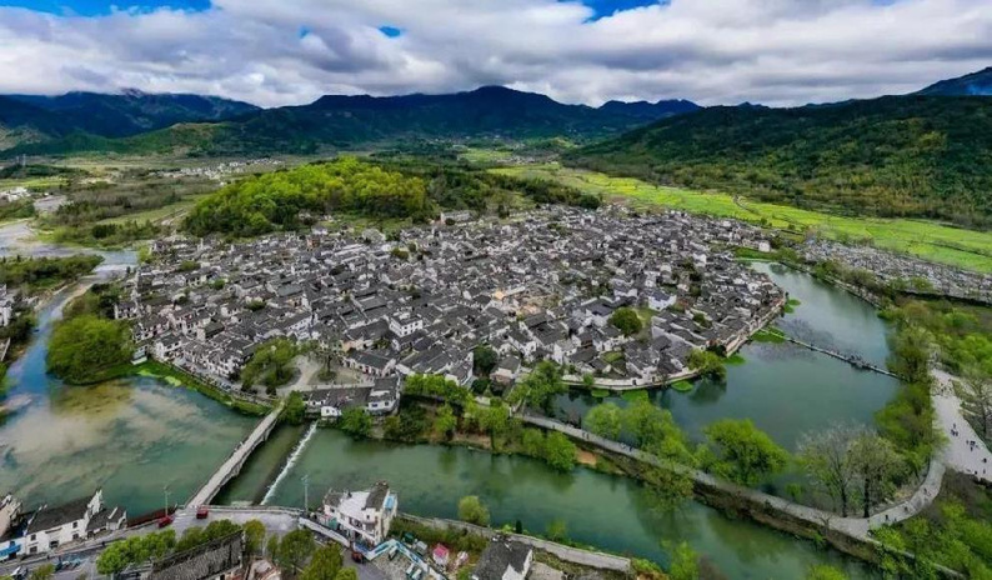
Hongcun village, Yi county, Huangshan city, Anhui province
The principle of “taking in moderation and using in moderation” promotes sustainable resource use, specifically focusing on natural materials and using local materials, such as the wooden structure in Wuling area of Hubei that flexibly adapts to the mountainous terrain and agricultural production methods. Construct with “local material” wooden structures, use ground-mounted stilt houses, “avoid impact on the land”. The construction process includes: Choosing a location, cutting down trees for materials, making pillars, processing parts, artistic carving, piercing beams, erecting beams, installing main beams, not using iron nails, ensuring natural insulation.
Hunan village in Qintong town, Jiangyan district of Taizhou, Jiangsu province: Lixiahe area has low terrain, the village is surrounded by rivers on all four sides, so it is necessary to choose a high place to live. The village has a high density, showing the shape of an island, with streets and alleys crisscrossing. Traditional houses are built along the river, with dense architecture, deep alleys, and narrow roads. Old houses located at intersections often have a “curved” construction style, with the lower part where two walls intersect being cut inwards, convenient for people to pass through, bringing benefits to both pedestrians and residents. Here, they focus on rural construction that combines organically with pristine natural elements, using traditional building materials such as green bricks, bamboo and wood, maintaining architectural characteristics.
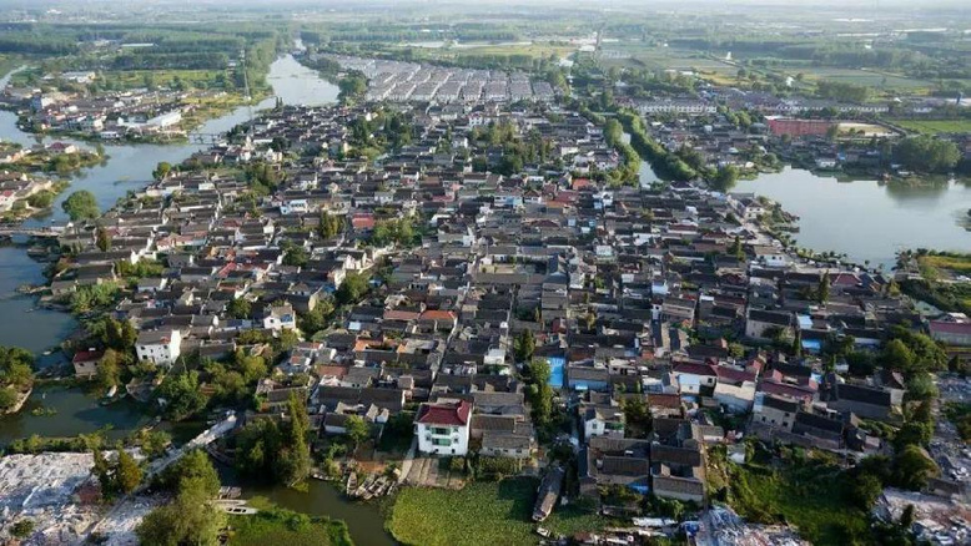
Hunan village in Qintong town, Jiangyan district of Taizhou, Jiangsu province
These principles form the basis of modern rural planning, minimizing environmental impacts by utilizing local resources and reducing waste. This in turn forms the basis for modern policies where green development is not just a choice but an imperative. According to Xi Jinping’s “Two mountains” theory - “Clear waters and green mountains are equal to mountains of silver and gold” - the environment is a valuable asset, promoting the transition from primitive to sustainable development.
3. Party guidelines and national policies on sustainable rural development in China
In recent congresses of the Communist Party of China, the issue of rural development has received special attention. The 18th National Congress (2012) of the Communist Party of China made a strategic decision to “Strengthen the construction of ecological civilization” from a new starting point in history. The Report of the 19th National Congress (2017) of the Communist Party of China pointed out that “It is necessary to accelerate the reform of the ecological civilization system and build a prosperous and beautiful China”. In particular, promote green development by developing clean energy and renewable energy; focus on solving outstanding environmental problems, especially improving the living environment in the rural area; reform the ecological environment monitoring system by defining and strictly complying with ecological protection boundaries; strengthen efforts to protect the ecosystem by implementing system protection and management. China has gradually moved from focusing on poverty alleviation to building “Beautiful countryside” and then “Rural revitalization”. In April 2021, China passed the “Law on Promotion of Rural Revitalization” to accelerate rural development while maintaining environmental protection measures.
In the Report of the 20th National Congress (2022), the Strategy for “Comprehensive Rural Revitalization” sets the goal of planning and building rural area from “orderly beauty” to “harmonious beauty”, closely linked to a green and sustainable natural environment. The focus is on strictly protecting agricultural land, building high-quality farming land, and promoting ecologically friendly farming. China emphasizes the “big food concept”, developing green, high-tech agriculture and a diversified supply chain, to reduce pressure on natural resources. At the same time, rural planning focuses on improving infrastructure and public services in the direction of “beauty and suitability for residence and employment”, associated with conservation of landscapes, preservation of indigenous culture and ecosystems. Strengthening the collective economy and local distinctive industries also aims at green development, increasing income while ensuring harmony with the environment.
By 2025, the Comprehensive Rural Revitalization Plan for the 2024-2027 period issued by the Party Central Committee and the State Council focuses on 9 major tasks, including optimizing the urban-rural model, ensuring food security, and improving rural ecology. In addition, the Government of China has issued a series of policies to integrate the environment into rural planning. Typically, the “Three-Year Action Plan on Rural Living Environment Improvement” (2018) focuses on waste and wastewater treatment and housing renovation. The Ministry of Housing and Urban - Rural Development promotes green housing: Safe, energy-saving, economical and healthy. By 2024, notices such as “Guidance on strengthening the training of rural construction workers” emphasize the preservation of traditional villages and improvement of environment. Central Committee’s Document No. 1 of 2025 reinforces these measures, emphasizing “green development” such as afforestation and organic agriculture, aiming to achieve significant progress in rural revitalization by 2027. International cooperation, such as the United Nations Sustainable Development Cooperation Framework for the People’s Republic of China 2026-2030, has integrated rural revitalization with Sustainable Development Goals (SDGs), focusing on sustainable agriculture and ecological protection.
4. Local practices: From theory to action
4.1. “Ten Million Project” in Zhejiang
The “Thousand villages demonstration and Ten thousand villages renovation" Project (Ten Million Project) is an important policy that General Secretary Xi Jinping personally planned, implemented and promoted when he was working in Zhejiang province. This is an important infrastructure project in building comprehensive rural area for a well-off society; a leading project to promote rural urbanization; an ecological work to harmoniously develop between people and nature, and at the same time a work for the people, aiming to establish a long-term mechanism for solving practical problems of the people. By 2023, this Project had been implemented for 20 years and achieved great achievements. The rural landscape of Zhejiang province has undergone profound changes, the rural living environment has been significantly improved through scientific planning, and living standards of farmers have been significantly improved. The Project has not only created an exemplary effect throughout the country, but has also been recognized internationally. It is considered a vivid practice and a great achievement of socialist thought with Chinese characteristics in the new era, especially in 3 aspects such as agriculture, rural area, farmers, opening up a highway for Zhejiang province to move towards environmentally friendly rural modernization.
The Project has achieved a fundamental change in the development of rural industries towards greening, moving the rural area from a "beautiful environment" to a "beautiful industry". Yu village, Anji county, closed the mines, and moved to the path of sustainable development. The village has renovated industrial parks, roads, canals, treated wastewater, classified waste, renovated agricultural land, and re-established development planning. From there, it has created channels to transform from a beautiful environment to a diversified economy and sustainable development.
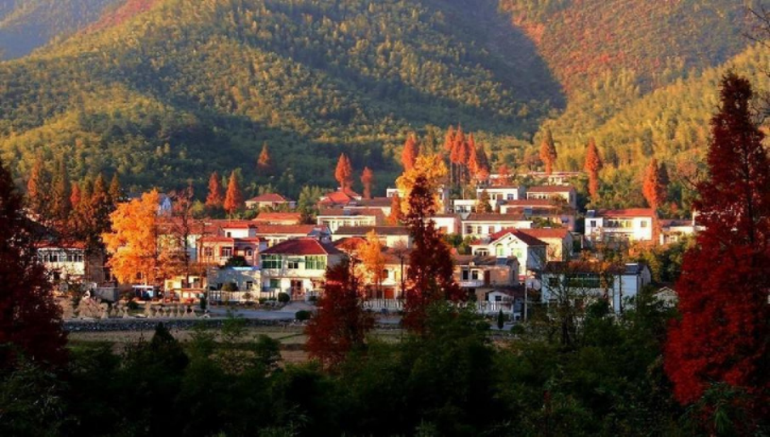
Yu village, Anji county, Zhejiang province
Xientan village, Deqing county, Huzhou city actively implemented the concept of “Clear waters and green mountains are equal to mountains of silver and gold”, relying on rich natural resources to develop a rural resort model. The village has created a green economic development path, in which each resort becomes a major industry, truly transforming the beautiful environment into a beautiful economy, using that development to nurture the ecosystem, towards “fair prosperity”.
“Technical regulations for building rich and beautiful rural area in the new era” require basing on different terrain characteristics such as mountainous areas, plains, islands, basing on functions of each village, geographical conditions, industry characteristics, traditional culture, natural resources to guide the classification for building villages. Through the “Four-level inter-connection” mechanism including district, commune, village and household levels, together with the “Five beautiful inter-connection” model, including beautiful villages, advanced exemplary districts and exemplary townships, scenic roads, beautiful gardens, a comprehensive beautiful structure is formed with the planning of “endless greenery, uninterrupted landscape, moving through villages to change scenery, every village has beautiful scenery”.
China is also known as a country that considers the protection of traditional villages an urgent project that cannot be delayed. Since 2012, the protection work has been carried out step by step and has made new progress every year, each year protecting and using key villages (43 villages) and more than 200 ordinary villages. Thanks to that, a large number of traditional villages have revived, brought new vitality, and preserved precious assets for future generations. Songyang is the oldest county in Lishui, Zhejiang, and is also the county with the largest number of villages listed in the “Traditional Village List” in China. This ancient town has more than 1,800 years of history, with more than 100 ancient villages have been preserved to date. This is one of areas with the most complete historical and cultural heritage preservation system and the best inherited local culture. The “China National Geographic Magazine” called this place “The Last Secret Paradise of Jiangnan”.
Opening the path of Chinese-style new rural modernization, leading rural area from “constructed beauty” to “shared beauty”, Huayuan village, Dongyang, Jinhua city is the basic unit leading the rural modernization work according to the model of “prosperous coexistence”, pioneering the construction of the 4,000m2 “Ten Million Project” exhibition hall, becoming the only pilot in the country on developing small towns in villages; the only pilot in the province on comprehensive reform in rural revitalization work. Huayuan village is truly a “modern rural area” in the integrated development between urban and rural areas.
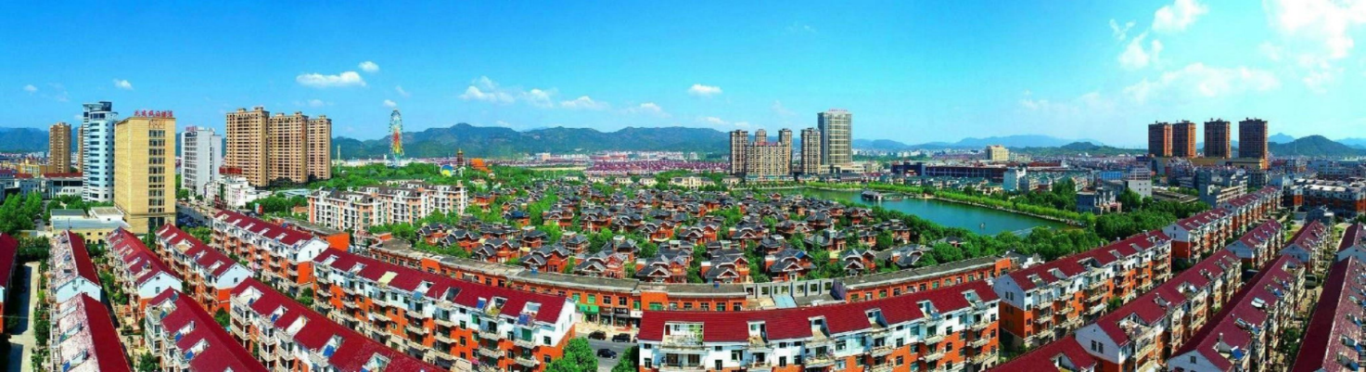
Huayuan village, Dongyang, Jinhua city
4.2. Practices in Jiangsu in building distinctive villages
The 1st period (2010-2014): Implemented throughout the province, mainly focusing on improving the environmental landscape and solving basic sanitation problems; The 2nd period (2015-2016): Carried out comprehensive improvement of the physical environment, taking pilot models and exemplary models as guides, developing pilot models with clear socio-economic impacts; The 3rd period (2017-2020): Piloted construction of distinctive rural villages; improved housing conditions for people in the Northern region of Jiangsu province; The 4th period (from 2021 to present): Jointly improved the living environment from "Towns, Villages and Houses", synchronously carried out construction planning, industry development, and rural management.
Since 2017, Jiangsu province has been implementing the construction of distinctive rural villages, focusing on three main themes: “Distinction, rural area, village”. The goal of this strategy is to evoke memories of the homeland, to aim for the picturesque rural life of the people, and at the same time to recreate the charm and appeal of villages, aiming to build a rural model of “lush ecology, beautiful villages, distinctive industries, prosperous farmers, strong collectives and good customs”.
Beihuaxiang town, Zhangpu county, Kunshan city, Jiangsu province, respects the traditional village structure, creating a traditional and aesthetic village landscape; building materials are selected to suit the locality, creating a typical rural atmosphere. Designers work directly in the village, seriously implement the established construction plan, and strictly control the development direction of construction works.
The rural resort area in the mountainous area of South Suzhou identifies the idea of “taking advantages of Gaoshan mountain, developing according to its strengths, using landscape to promote the countryside, combining landscape with the countryside” to clarify the role of the village as an important supplementary element to the function of Gaoshan mountain tourist area.
5. Conclusion
China has built a green rural model through planning harmonious with nature, sustainable infrastructure and environmental protection. Projects such as the “Ten Million Project” not only improve the living environment but also promote common prosperity. With progress towards 2025, this model will not only solve internal problems but also contribute to the global SDGs.
Phạm Văn Bộ
Academy of Construction Strategy and Cadres Training
(Source: The article was published on the Environment Magazine by English No. IV/2025)
REFERENCES